











 394
394
Online 2D and 3D configurators are increasingly becoming a part of digital sales – from e-commerce and B2B catalogs to complex products in manufacturing, automotive, and interiors. They help display the product in the desired configuration, shorten the ordering process, and reduce the number of errors during the selection process.
It's important for businesses to understand how much a configurator will cost to develop and what exactly the price includes. Even when comparing proposals, it becomes clear that budgets for 2D and 3D configurators can differ significantly, even with similar visual results.
The reason is that configurators don't have a fixed price. They're not ready-made modules, but rather custom solutions, with pricing depending on the product's logic, number of parameters, visualization level, performance requirements, and integrations. At Avada Media the pricing of such projects is based on business objectives and use cases - these determine the final scope of work and budget.


Why do 2D and 3D configurators have different prices?
The difference in cost between 2D and 3D configurators is related to the level of complexity and the role of the solution in the business, and not just the visualization format.
Key differences:
- Difficulty of implementation
The 2D configurator works with the interface and state sets. The 3D configurator operates on an interactive scene in real time, which requires a more complex architecture and more development. - Visualization and logic
In 2D, the visual layer is separated from the logic. In 3D, they are closely linked: any change to the parameters must be correctly and instantly reflected in the model. - Performance and UX
3D solutions place high demands on performance in the browser and on mobile devices, which increases the scope of optimization and testing. - Business expectations
2D configurators often solve selection problems. 3D configurators become part of the sales and product presentation process, which influences the depth of development and budget.
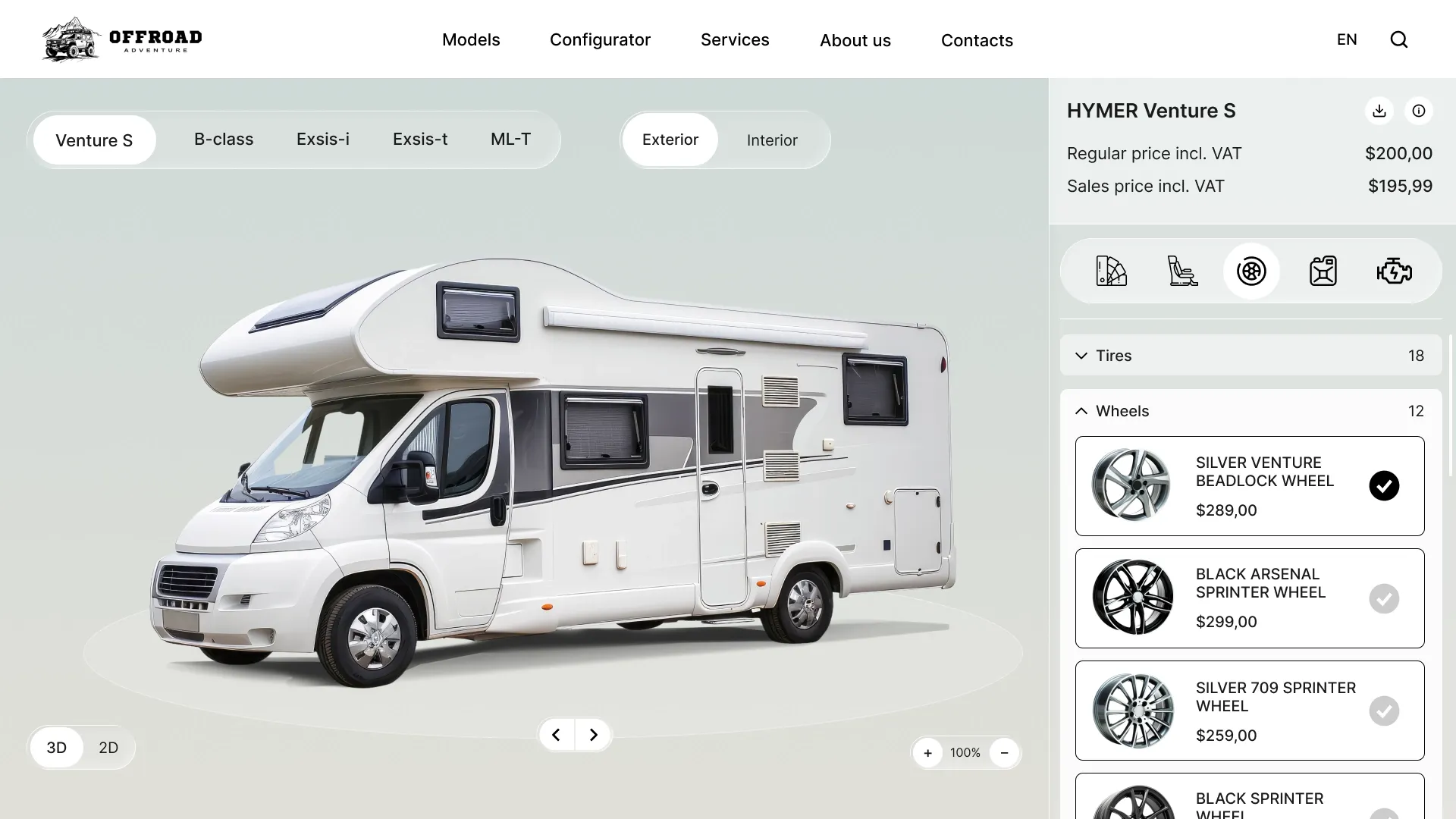
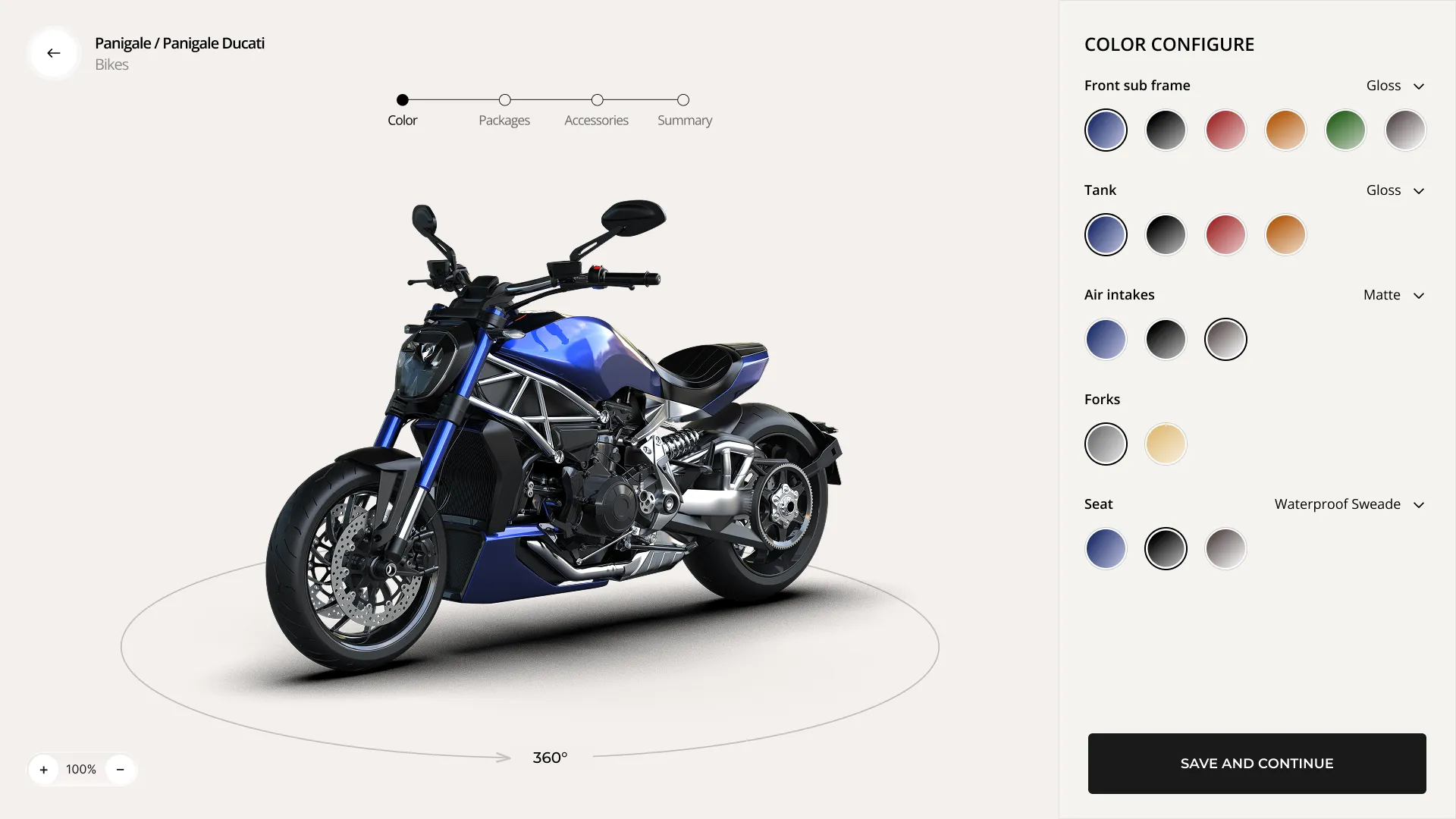
What is a 2D configurator and when is it sufficient?
A 2D configurator is a tool for selecting product parameters through an interface without the use of an interactive 3D model. The user configures product characteristics, and the results are displayed as static images, layers, or diagrams.
Typical features of the 2D configurator:
- Selection of parameters via UI (color, size, configuration, options);
- Displaying the result using images or their combinations;
- Simple logic without complex dependencies between parameters.
This format is a rational choice when:
- The product has a simple structure and clear selection logic;
- The number of possible variations is limited;
- The cost of an ordering error is low and does not require detailed visual inspection.
In terms of budget the price of a 2D configurator typically ranges from $4,000 to $5,000. The final cost depends on the number of parameters, the complexity of the business logic, the level of UI/UX design, and the need for integrations. 2D configurators are faster to implement and require fewer resources, but are not suitable for all products, especially those requiring detailed interactive visualization or high selection accuracy.

What is a 3D configurator and why is it more expensive?
The 3D configurator allows you to configure a product through an interactive 3D model in real time. Users can rotate the object, zoom in, and see the results of their selected parameters immediately.
Why are 3D configurators more expensive?
- The visual layer and logic are closely linked: any change in parameters is immediately reflected in the model.
- Performance and UX: High demands on stability in the browser and on mobile devices.
- Technologies: Typically uses WebGL / Three.js and complex frontend development.
- Additional costs for the development or purchase of 3D models.
- Business expectations: 3D configurators often become part of the sales process, not just visualization.
When a 3D configurator is needed:
- The product is complex, multi-component or visually significant;
- Accurate visualization is required to support sales and presentations;
- The 2D configurator is not able to convey all the options and interactions.
In terms of budget, the cost of a 3D configurator is always a matter of individual preference. Basic 3D configurators typically start at $10,000, while full-fledged solutions deeply integrated into sales and business processes can cost as much as $30,000. The final price directly depends on the number of parameters, the level of visualization, the complexity of integrations, as well as UX and performance requirements.
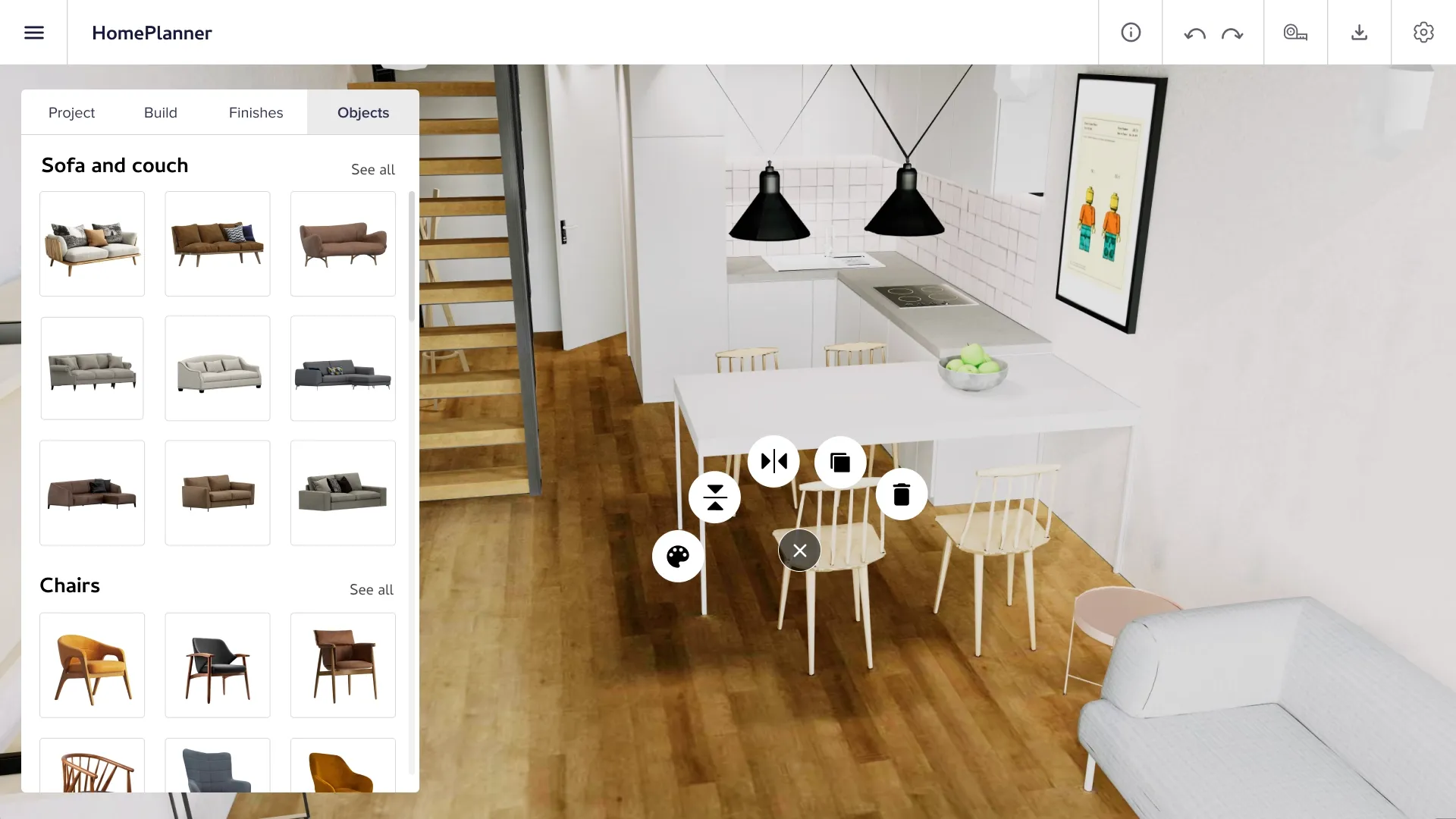

What components determine the cost of development?
The cost of developing a 2D or 3D configurator consists of several key components, each of which requires time and expertise.
Analytics and design
At this stage, the product's business logic, use cases, and user flows are studied. Configuration rules and constraints that will affect the configurator's operation are defined. The more complex the product and the deeper the dependencies between options, the higher the effort required.
UI/UX design
Interface design creates a user-friendly experience for both desktop and mobile users. A good user experience reduces errors, speeds up selection, and directly impacts sales efficiency, so interface design is an integral part of the overall cost.
2D/3D models
Creating the visual component involves the number of models, the level of detail, web optimization, and work with textures, PBR materials, and animations. The more realistic and interactive the models, the more resources are required to prepare them.
Frontend development
Implementing interactivity and visual effects on a website often uses WebGL / Three.js. Performance, responsiveness, and synchronization with configuration logic are important. Complex interfaces and animations increase the amount of front-end development.
Backend and business logic
Compatibility rules, configuration cost calculations, variant storage, and version management are all supported. The more dependencies and scenarios, the greater the complexity of the backend.
Integrations
The configurator often integrates with CRM systems for leads and orders, ERP systems for catalogs and pricing, e-commerce systems for product cards, shopping carts, and checkouts, and analytics systems. Each integration requires additional development and testing.
Testing and optimization
Cross-browser compatibility, mobile performance, load testing, and UX testing are essential. A well-tested configurator reduces risks and improves product efficiency, but increases the development budget.

What factors most influence price?
A 2D vs. 3D configurator isn't just a visual difference. The choice of format determines the complexity of the project: the number of parameters, the level of visual detail, integration, and UX requirements directly impact the development budget.
Key factors:
- Number of parameters and dependencies - the more options, the more complex the logic.
- Depth of customization – detailed settings increase labor costs.
- Visual realism level – detailed 3D models and animations require resources.
- The number of integrations – connecting CRM, ERP, and e-commerce - complicates the backend.
- Scaling requirements – the growth of users and options impacts the architecture.
- Mobile-first requirements – responsiveness and performance on mobile devices add work.
Even a simple product can be expensive if it combines several complex requirements.
Why template solutions are cheaper - and what are their limitations?
Template configurators are often attractive due to their low cost and quick implementation, but they have their limitations.
Main disadvantages:
- Fixed logic – product customization options are limited to predefined options.
- Poor scalability – expanding functionality or adding new options is often impossible without a complete redesign.
- Integration limitations – connecting to CRM, ERP, or e-commerce may be difficult or impossible.
It's important to understand: template solutions aren't suitable for everyone. They're effective for simple products with a limited number of parameters, but they don't replace a full-fledged custom 2D or 3D configurator for complex tasks.

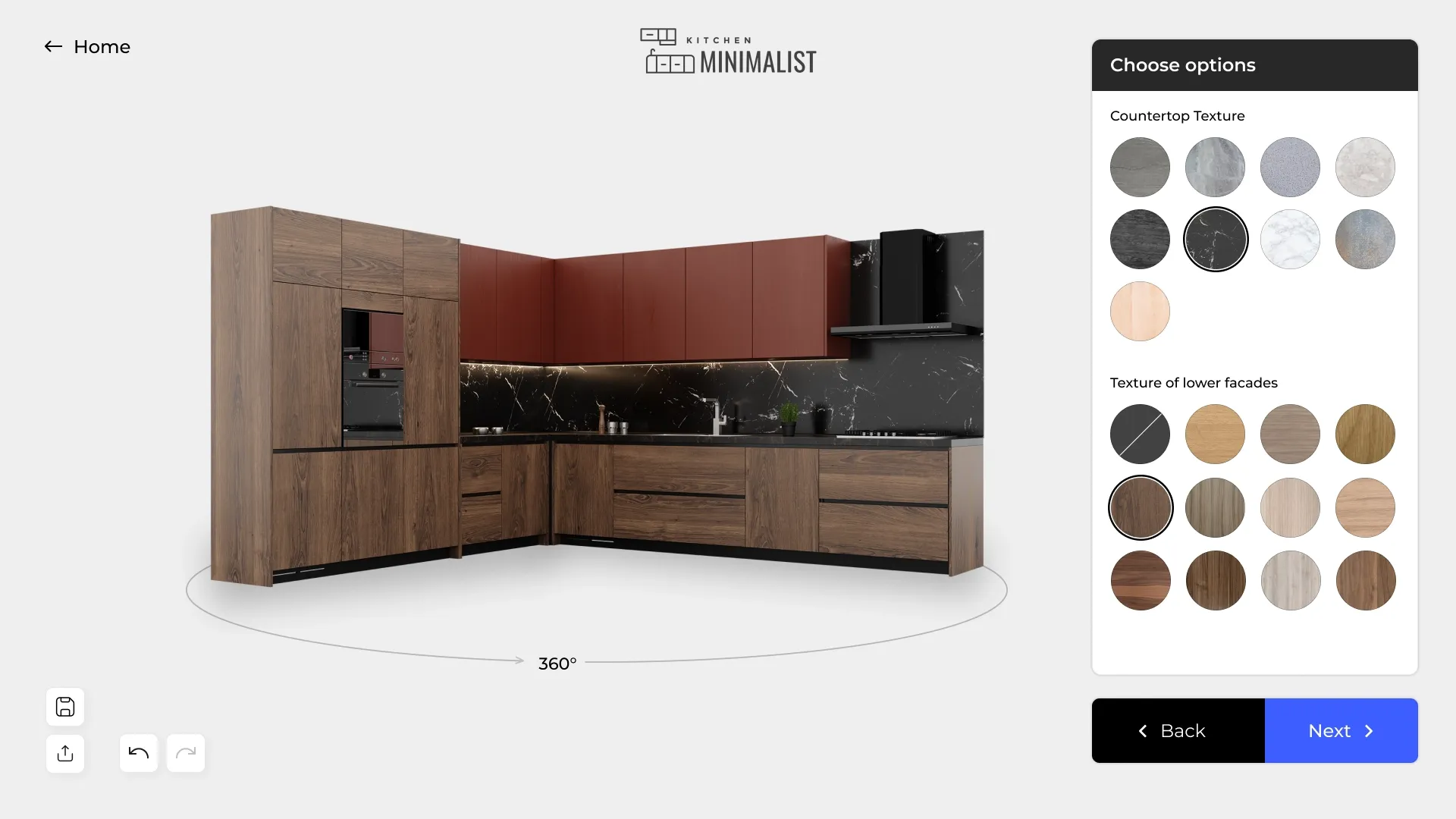
How does cost relate to the ROI of a 3D configurator?
The higher cost of developing a 3D configurator is often justified by the high return on investment. ROI is determined not only by visual appeal, but by tangible business benefits:
- Accelerated sales – customers choose products and place orders faster.
- Reduced workload for managers - less manual work and consultations.
- Reduced errors – accurate visualization reduces the likelihood of making the wrong choice.
- Increased average check – customers are more likely to choose additional options thanks to visual presentation.
This approach allows you to go beyond investing in visualization and create a solution that improves sales efficiency and reduces internal costs. AVADA MEDIA helps businesses formulate development budgets based on these factors and create configurators that deliver tangible results.
Example of the cost and development time for 2D/3D configurators
Below is an approximate table of the cost and implementation time for 2D and 3D configurators for various types of products.
| Configurator type | Product example | Main functionality | Implementation timeframe | Estimated cost |
|---|---|---|---|---|
| 2D configurator (basic) | Footwear, clothing, accessories | Choice of color, size, options, static images | 4–8 weeks | $4,000–5,000 |
| 2D configurator (advanced) | Gadgets, furniture | Parameter dependencies, price calculation, configuration saving | 7–10 weeks | $6,000–9,000 |
| 3D configurator (basic) | Product with one model | Rotation, zoom, change of materials and colors | 8–12 weeks | From $10,000 |
| 3D configurator (medium) | Furniture, appliances, motorcycles | Several models, dependency logic, cost calculation | 12–15 weeks | $15,000–25,000 |
| 3D configurator (advanced) | Cars, houses, interiors | Complex logic, scenes, animations, integrations | 4–6 months | From $30,000 |
| 3D planner/visualizer | Kitchens, houses, rooms | Spatial assembly, cameras, scenarios, layout | 6–10 months | $40,000–70,000+ |
*The cost is approximate and depends on the complexity of the business logic, the number of parameters, the level of visual realism, and the number of integrations.
How to approach your development budget rationally
When planning a budget for 2D and 3D configurator development, it's important to consider strategy, not just cost. This approach may include several key elements:
- MVP vs. full-fledged product – at the first stage, you can implement a minimum viable configurator to test the idea and understand user behavior. The full-fledged product is developed as the business value is confirmed.
- Phased development - breaking the project into stages reduces risks and allows for budget adjustments as progress progresses.
- Feature prioritization – key capabilities that deliver the greatest impact for the user and business are implemented first.
- The configurator evolves over time – its functionality and visuals can be expanded gradually, which distributes costs and allows for adaptation to new challenges.
This approach helps control costs and improve investment efficiency. AVADA MEDIA team supports projects at every stage, offering a flexible configurator development strategy tailored to specific business goals.


