









Apartment configurator
When choosing an apartment or designing an apartment, it's important for the client to not just familiarize themselves with the layout but to form a holistic vision of the future space. Details are crucial: furniture arrangement, available space, a sense of proportion, and the perceived comfort of the space. These factors directly influence the purchasing decision.
Static plans and renderings provide a general idea of the project, but they don't always allow for an objective assessment of scale, ceiling height, spatial depth, and actual ergonomics. For a complete understanding, instrumental modeling is necessary, demonstrating not only the geometry but also the spatial perception of the interior.
The development of a 2D and 3D apartment configurator solves this problem. This interactive tool combines fast 2D planning, precise 3D geometry, and clear visualization in a single system. For businesses, this means automated sales, fewer approvals, and a more streamlined application process.

What is a 2D and 3D apartment configurator and how does it work?
The Apartment Configurator is an online tool for planning and visualizing living spaces that runs in your browser without installing any additional software. It allows you to create an apartment layout, adapt it to specific needs, and create a digital model that closely resembles real-life conditions.
Developing such a solution involves not just visualizing a space, but creating a complete system with constraint logic, object parameterization, and the ability to integrate into a company's business processes.
Depending on the project objectives, the configurator can be implemented in three formats:
- separate 2D configurator;
- separate 3D configurator;
- a combined solution that combines both modes.
The choice of format is determined by the budget, the level of detail required, and sales scenarios.
2D Apartment Configurator Features
The 2D configurator is designed for speed, simplicity, and intuitive interaction. It serves as the first stage of planning and allows you to quickly create a basic apartment configuration.
The 2D format functionality includes:
- creation of an apartment plan taking into account the specified dimensions;
- dividing space into functional zones;
- placement of furniture and equipment;
- free movement of objects;
- changing the texture and color scheme of the walls;
- formation of a preliminary project for the transition to 3D.
This approach allows the client to create a visual image of the future space in just a few minutes.
For businesses, this is a convenient engagement tool that prepares users for more detailed 3D development and project handover.
3D Apartment Configurator Features
The 3D configurator transforms a preliminary sketch into a precise digital model, taking into account geometry, parameters, and technical constraints.
1. Geometry and accuracy
The 3D system works with real parameters and takes into account:
- room dimensions in millimeters;
- ceiling height;
- thickness of walls and partitions;
- location of window and door openings;
- door opening direction;
- placement of utility lines.
The model is based on precise geometry, eliminating discrepancies between the visual diagram and the actual layout. The user sees the actual configuration of the space, not a conventional 2D diagram.
The system automatically checks the correctness of the parameters and does not allow technically impossible options.
2. Interior and objects
Depending on the project objectives, the 3D configurator can use different levels of detail:
- schematic models of furniture and equipment for engineering calculations;
- detailed 3D objects for presentation visualization;
- customizable wall, floor and ceiling textures;
- various zoning options (studios, open-space, combined kitchen-living rooms).
We design the solution architecture in such a way that the client can flexibly manage the visualization level – from a functional engineering model to the most realistic demonstration for the client.
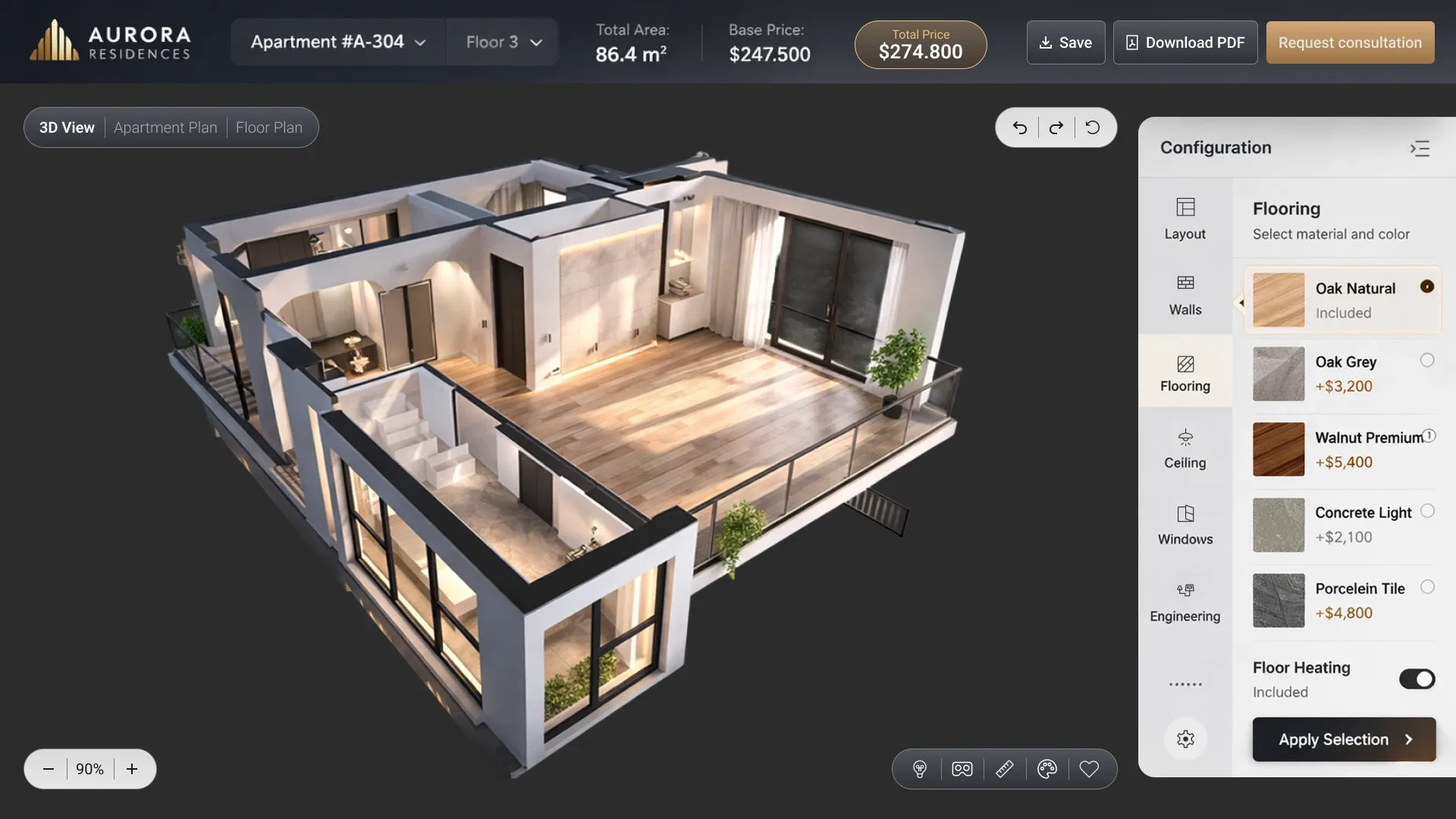
3. Navigation and ergonomics testing
The 3D mode allows you to not only see the layout, but also "walk" through the apartment:
- move between rooms;
- view space from different angles;
- check distances between objects;
- evaluate the convenience of furniture placement.
This is especially important when selling small apartments, where every centimeter impacts comfort. The client can ensure in advance that the chosen configuration meets their expectations.
4. Performance and scalability
When developing the 3D apartment configurator, special attention was paid to geometry optimization and object separation. This ensures stable system operation:
- on computers;
- tablets;
- 4Performance and Scalability
High performance allows the configurator to be used as a mass-market tool on a developer's website without the risk of overload or a degraded user experience.
5. Commercial and integration block
The 3D configurator can be integrated into the company's digital ecosystem and include:
- generating an application with the selected configuration;
- transferring parameters to CRM;
- automatic cost calculation;
- preparing specifications for the engineering department.
Thus, the interactive 3D apartment configurator becomes not just a visual module, but a part of the sales and preliminary design system.
It unites the work of the client, manager, and engineer in a single digital environment and ensures transparency at every stage of the transaction.


Possibilities of a combined 2D + 3D solution
A combined 2D and 3D configurator combines the speed of sketch planning and the precision of a 3D model in a single system. This format allows for a consistent and user-friendly user experience, from initial selection to detailed space inspection.
When implementing a combined solution, the system can provide:
- automatic synchronization of changes between 2D and 3D modes;
- correct transfer of dimensions and parameters from the diagram to the three-dimensional model;
- automatic checking of constraints when switching from 2D to 3D;
- saving the configuration for subsequent refinement by a manager or engineer;
- formation of a single application with planning parameters and visualization.
This approach allows 2D to be used as a tool for rapid client engagement, and 3D to be used as a stage for precise verification and final presentation.
For businesses, this means a more manageable process: the client follows a logical path within the system, and the company receives structured data without losing parameters between modes.
The combined solution is particularly effective in projects with variable layouts, individual modifications and the need for preliminary engineering verification.

Where is the 2D/3D apartment configurator used?
The development of a configurator is in demand in segments where visibility, layout variety, and customer engagement in the selection process are important. This tool allows companies not only to showcase properties but also to build a digital model for interacting with buyers.
The solution is effectively applied to:
- Residential complex developers
The online floor plan configurator allows you to preview apartment options even during the construction phase. Clients can explore the space, change the zoning, and evaluate furniture arrangements before the property is completed. - Apartment developers
An interactive 2D and 3D configurator helps you present standard and custom layouts, tailor them to your needs, and speed up the booking process. - Design studios
The tool is used for preliminary interior planning, coordinating furniture arrangement, and demonstrating the concept to the client in a visual format. - Architectural bureaus
Allows you to test various zoning scenarios and check the ergonomics of the space before moving on to detailed design documentation. - Turnkey repair companies
The system helps clients independently create a basic configuration, and specialists quickly prepare estimates and commercial proposals. - Companies engaged in the redevelopment and reconstruction of housing
The configurator can be used to demonstrate acceptable redevelopment options, coordinate changes and provide preliminary project assessments.
The combination of 2D and 3D formats is particularly effective in projects where client involvement is essential. The user first creates a sketch and then receives a precise 3D model that is as close to reality as possible.
We design these solutions tailored to the client's specific business model – from presenting standard layouts to creating a fully-fledged digital platform for real estate sales.

Technologies and approach to development
The development of a 2D and 3D apartment configurator is based on modern web technologies and a scalable architecture. To implement the interactive apartment configurator, we use:
- WebGL and Three.js – for building a 3D scene, working with geometry, lighting, and materials;
- HTML, CSS, JavaScript, React, Vue and Next.js – for developing interfaces and interaction logic;
- Optimization of geometry, textures, and scene structure – for stable operation in the browser without loss of performance.
When developing the 3D apartment configurator, special attention is paid to balancing visual detail and loading speed. We optimize models, adjust levels of detail, and separate scene objects so that the system works correctly on computers, tablets, and smartphones.
Solution architecture
We build the technical architecture from the ground up not as a separate "visual block," but as a fully-fledged, scalable system. This means the configurator can be developed and expanded, adding new layouts, objects, functions, and integrations without redesigning the entire platform from scratch.
The architecture initially includes:
- the ability to add new layouts without reworking the core system;
- expansion of the catalogue of furniture and interior objects;
- connection of calculation formulas and commercial modules;
- integration with CRM, website and internal systems;
- stable operation under high user load.
- administrative panel for managing the configurator
At Avada Media, we design 2D and 3D configurators as part of the company's digital ecosystem. The solution integrates visualization, order collection, parameter calculation, and data transfer into a single technical framework.
Stages of developing a 2D/3D apartment configurator
Our team works using a phased approach, which helps us manage deadlines, quality of implementation, and the solution's alignment with the client's actual business objectives.
- Analytics and problem statement
During the first stage, we study floor plan types, housing stock characteristics, target audiences, and sales scenarios. We analyze the company's business processes, application processing logic, and potential integrations, and based on these results, we formulate the technical specifications and architecture of the future system. - Designing UX and Configuration Logic
We define the interface structure, user action sequences, and interaction scenarios. The main goal is to make the 2D and 3D real estate planning process intuitive for clients and convenient for businesses. - Preparation of 2D diagrams and 3D models
Floor plans, furniture, textures, and interior elements are created and optimized. Particular attention is paid to balancing detail and performance to ensure the configurator runs smoothly in a browser across devices. - Development of logic and constraints
Room parameters, object placement rules, and automatic dimension checks are configured. The system eliminates invalid configurations and ensures the technical correctness of the model. - Integration with digital infrastructure
The configurator connects to the website, CRM, cost calculation systems, and other internal services. This allows for the automatic transfer of requests, layout parameters, and commercial data. - Testing
We test the stability of the system on computers, tablets, and smartphones. We also test load scenarios, display accuracy, and constraint logic. - Launch and further development
After implementation, we support the project: we train the client's team, expand the catalog of objects if necessary, and add new features and integrations.

Cost of developing a 2D/3D apartment configurator
The cost of developing a 2D or 3D apartment configurator depends on the scope of functionality and the level of integration into the company's business processes. The price is influenced by:
- implementation format (2D, 3D or a combination of both);
- number of layout types;
- complexity of logic and automatic restrictions;
- availability of calculation formulas;
- visualization level;
- integration with CRM, website and internal systems.
Below are some sample decision formats to help you get a basic understanding of the budget.
| Type of solutions | Description | Estimated cost | Development timeframes |
|---|---|---|---|
| Basic 2D configurator | Creation of layouts, zoning, furniture placement, application submission | from $8,000 | from 2 months |
| Basic 3D configurator | 3D visualization of rooms with precise dimensions, without cost calculations | from $12,000 | 3-4 months |
| 3D with variability | Several layout types, object catalog, constraint logic | from $15,000 | 3-4 months |
| 3D with cost calculation | Dynamic price calculation, order generation, CRM integration | from $20,000 | 3-4 months |
| Fully featured solution | Advanced scenarios, integrations, specifications, commercial modules | from $30,000 | 5–6 months |
| Enterprise platform | High load, complex architecture, dealer accounts, scaling | from $45,000 | 6+ months |
The prices listed are approximate. The exact cost of developing a 2D or 3D apartment configurator is calculated after a consultation, layout analysis, and determination of the project's technical requirements.
At Avada Media, after a preliminary project discussion, we develop a mockup of the future configurator, create a technical specification describing the logic and functionality, and based on this, calculate the exact cost and timeline for implementing your solution.

How justified is the investment in developing a configurator?
The apartment configurator is a fully functional customer interaction channel. It offers buyers a clear and intuitive way to choose a layout, evaluate the space, and make a decision without complex explanations or additional consultations.
For business, this is:
- structured applications with specified parameters;
- reducing the number of errors and re-approvals;
- reducing the workload on managers and engineers;
- a more predictable and manageable sales process.
Payback and ROI
Investments in developing 2D and 3D apartment configurators pay off due to several factors:
- increasing the conversion rate from website visitors to applications;
- reduction of the transaction cycle;
- increasing the average bill due to additional options;
- reducing operational costs for consultations and manual calculations
- the ability to sell remotely without the additional expense of showrooms.
In fact, the configurator begins to work as a digital sales manager, available 24/7.
When scaling a project (adding new layouts, residential complexes, furniture catalogs), the ROI increases, since the basic architecture has already been created and requires minimal expansion costs.
The system is scalable, integrates with the company's internal processes, and, if necessary, can be supplemented with advanced visualization, calculation modules, or AR/VR functionality.
As a result, the company receives not a one-time tool, but a long-term platform that directly impacts sales growth and business efficiency.
Let's discuss your task
At Avada Media , we develop 2D and 3D apartment configurators tailored to specific layouts, business models, and customer sales scenarios.
Before starting the project we:
- We analyze apartment types and target audiences;
- we define the configuration logic and restrictions;
- we are working on integrations with the website and CRM;
- We form the solution architecture and implementation stages.
The result is not just a visual tool, but a scalable system integrated into your sales and preliminary design processes.
Contact us to discuss your project and receive a preliminary estimate of the development timeline and budget.


FAQ
-
Will developing a 2D/3D configurator pay off for my business?
In most cases, yes. The configurator increases website conversion, shortens the sales cycle, and reduces the workload for managers. It also increases the average order value by visually selecting options. The return on investment depends on sales volume and the monetization model, but with active use, ROI becomes noticeable within the first few months after launch.
-
Is a 2D configurator suitable for us or do we need a 3D one right away?
It depends on the business objectives.
- The 2D configurator is effective for quickly selecting layouts and engaging the client.
- A 3D configurator is essential if precise dimensions, ergonomics, and a realistic presentation of the space are important.
In a number of projects, the optimal solution is to combine 2D and 3D in one system.
-
Is it possible to develop a configurator for our layouts and business processes?
Yes. At Avada Media , we create solutions tailored to specific apartment types, constraints, property catalogs, and sales scenarios. The configurator adapts to the residential complex's architecture and the company's internal processes.
-
Is it possible to integrate the configurator with CRM and the website?
Yes. The online floor plan configurator can be integrated into an existing website and connected to a CRM. Requests, floor plan parameters, and selected options are automatically transferred to managers for further processing.
-
How long does development take?
Timeframes depend on the project's complexity and scope of functionality. Basic solutions are launched within two months. Full-fledged 2D and 3D configurators with constraint logic and integrations require three to four months of development. Exact timeframes are determined after requirements analysis and consultation.